How To Get Triamcinolone 0.1% Cream

47%
of patients treated with topical triamcinolone achieved at least a 75% improvement in eczema severity after four weeks.
Source: National Library of Medicine
Sorry, we’re closed for today. Our U.S. licensed medical providers are available daily 7 a.m. to 9 p.m. CST via live video visit. We look forward to serving you soon. Email us anytime at [email protected].
Triamcinolone Acetonide 0.1% Cream FAQs
-
Triamcinolone acetonide 0.1% cream is a topical used to treat the itching, redness, dryness, crusting, scaling, inflammation and discomfort of various skin conditions, including psoriasis (a skin disease in which red, scaly patches form on some areas of the body) and eczema (a skin disease that causes the skin to be dry and itchy and to sometimes develop red, scaly rashes). It is also used as a dental paste to relieve the discomfort of mouth sores. Triamcinolone is in a class of medications called corticosteroids. It works by activating natural substances in the skin to reduce swelling, redness and itching.1
-
Triamcinolone comes in ointment, cream, lotion and aerosol (spray) in various strengths for use on the skin and as a paste for use in the mouth. It usually is applied two to four times a day. For mouth sores, it is applied at bedtime and, if necessary, two or three times daily, preferably after meals. Follow the directions on your prescription label carefully and ask your doctor or pharmacist to explain any part you do not understand. Use triamcinolone exactly as directed. Do not use more or less of it or use it more often than prescribed by your doctor. Do not apply it to other areas of your body or use it to treat other skin conditions unless directed to do so by your doctor.
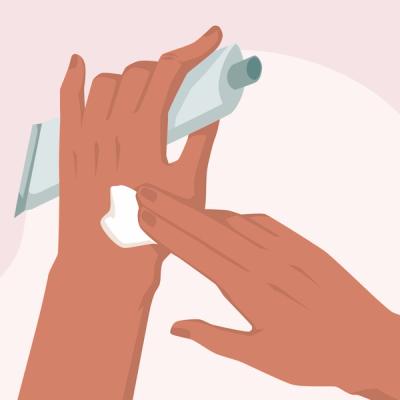
To use triamcinolone topical, apply the ointment, cream, or lotion sparingly in a thin film and rub it in gently.
If you are using triamcinolone topical on your face, keep it out of your eyes. Do not apply other skin preparations or products on the treated area without talking with your doctor.2
-
You may notice improvement within a few days, but exact timing will depend on the condition being treated and how severe it is.3
-
Yes, triamcinolone acetonide cream is a topical corticosteroid, commonly referred to as a “steroid.”4
-
No, triamcinolone acetonide cream is not an antifungal. It is a topical corticosteroid or “steroid.”5
-
Triamcinolone cream and ointment contain the same active ingredient, just in a slightly different form. The main difference is the ratio of oil and water in the medication — a cream is 50% oil and 50% water, while an ointment is 80% oil and 20% cream. This means creams are more easily absorbed by your skin, while ointments sit on top of the skin. Your doctor will help you determine what’s best for your condition. A cream may be better for larger patches of skin, while an ointment may work best for smaller areas or extremely dry skin.6
-
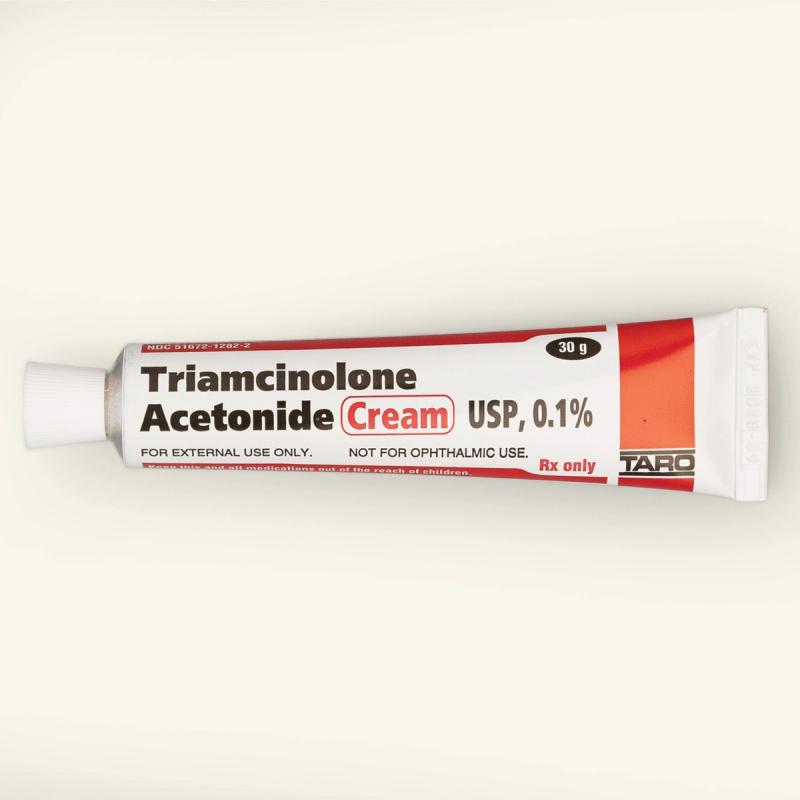
Triamcinolone acetonide 0.1% cream through RedBox Rx costs $25 for a 30 g tube or $35 for an 80 g tube following a $39 online consult.
You save money on your doctor consult fee by selecting RedBox Rx pharmacy and having treatment shipped to your address. The consult fee increases to $69 if another pharmacy is used.
-
No, triamcinolone acetonide cream requires a doctor’s prescription.7
-
RedBox Rx offers triamcinolone acetonide cream at 0.1% strength, but it can be found in other potencies.
-
Triamcinolone acetonide cream is available in 30 g and 80 g tubes from RedBox Rx.
-
Drug interactions are not expected with triamcinolone acetonide cream, but it is always best to give a list of your other current medications to your doctor to ensure it is safe to use.8
-
Yes, triamcinolone acetonide cream expires. Check the expiration date of your prescription and always properly dispose of expired medication.
-
Before using triamcinolone topical:9
Tell your doctor and pharmacist if you are allergic to triamcinolone, any other medications, or any of the ingredients in triamcinolone topical products. Ask your pharmacist for a list of the ingredients.
Tell your doctor and pharmacist what other prescription and nonprescription medications, vitamins, and nutritional supplements you are taking or plan to take.
Tell your doctor if you have an infection in your mouth or throat or if you have ever had diabetes or Cushing's syndrome (an abnormal condition that is caused by excess hormones (corticosteroids)).
Tell your doctor if you are pregnant, plan to become pregnant, or are breastfeeding. If you become pregnant while using triamcinolone topical, call your doctor.
-
No, you should not use triamcinolone acetonide cream on your face unless directed by your doctor. This can lead to side effects such as acne, prominent blood vessels, skin thinning, changes in skin color or unwanted hair growth.10
-
No. Triamcinolone acetonide cream should not be used on the face and doing so may cause acne in addition to other side effects.11
-
No. Triamcinolone acetonide cream should not be used on the genitals unless directed by your doctor.12
-
You should not use triamcinolone acetonide cream on your face, groin, genitals (private parts), under the breasts or on your armpits unless directed by your doctor. Using triamcinolone in these areas may lead to unwanted side effects like acne, prominent blood vessels, skin thinning (atrophy), changes in skin color or unwanted hair growth. If you are breastfeeding, do not apply triamcinolone topical to the nipple or the area around it.13
-
Yes, potential side effects of acetonide cream include lightened or discolored skin. If this occurs, consult your healthcare provider immediately.14
-
Apply the missed dose as soon as you remember it. However, if it is almost time for the next dose, skip the missed dose and continue your regular dosing schedule. Do not apply a double dose to make up for a missed one.15
-
Side effects from triamcinolone can occur. Tell your doctor if any of these symptoms are severe or do not go away:
Burning, itching, irritation, stinging, redness or drying of the skin
Acne
Change in skin color
Unwanted hair growth
Tiny red bumps or rash around the mouth
Small white or red bumps on the skin
If you experience any of the following symptoms, call your doctor immediately:
Severe rash
Redness or swelling or other signs of skin infection in the place where you applied triamcinolone
Triamcinolone topical may cause other side effects. Call your doctor if you have any unusual problems while using this medication.
If you experience a serious side effect, you or your doctor may send a report to the Food and Drug Administration's (FDA) MedWatch Adverse Event Reporting program online (http://www.fda.gov/Safety/MedWatch) or by phone (1-800-332-1088).16
-
Keep this medication in the container it came in, tightly closed and out of reach of children. Store it at room temperature and away from excess heat and moisture (not in the bathroom). Do not freeze it.
Unneeded medications should be disposed of in special ways to ensure that pets, children and other people cannot consume them. However, you should not flush this medication down the toilet. Instead, the best way to dispose of your medication is through a medicine take-back program. Talk to your pharmacist or contact your local garbage/recycling department to learn about take-back programs in your community. See the FDA's Safe Disposal of Medicines website (http://goo.gl/c4Rm4p) for more information if you do not have access to a take-back program.
It is important to keep all medication out of sight and reach of children as many containers (such as weekly pill minders and those for eye drops, creams, patches and inhalers) are not child-resistant and young children can open them easily. To protect young children from poisoning, always lock safety caps and immediately place the medication in a safe location, out of their sight and reach. Learn more at http://www.upandaway.org.17
-
With topical forms triamcinolone acetonide including the cream and ointment, absorption will vary based on where it is applied, how much is applied, the strength of the medication and the specific condition of the patient.18
-
If someone swallows triamcinolone topical, call your local poison control center at 1-800-222-1222. If the victim has collapsed or is not breathing, call local emergency services at 911.19
-
Keep all appointments with your doctor and the laboratory. Your doctor may order certain lab tests to check your body's response to triamcinolone.
Do not let anyone else use your medication. Ask your pharmacist any questions you have about refilling your prescription.
It is important for you to keep a written list of all of the prescription and nonprescription (over-the-counter) medicines you are taking, as well as any products such as vitamins, minerals, or other dietary supplements. You should bring this list with you each time you visit a doctor or if you are admitted to a hospital. It is also important information to carry with you in case of emergencies.20
-
We offer a variety of prescription medication options for skin rashes, hives, and eczema including:
RedBox Rx Reviews
-
“
Unbelievable! My prescription for the requested skin care product was filled and sent in less than 2 hours. Also, the pricing is very affordable. -Ann M.
-
“
Finally a source to get a prescription medicine that does not require nor need a doctor visit! I needed a skin cream that I only use during the winter months. Making a doctor's appointment just to get a prescription refilled was too expensive. I tried RedBox Rx. Answered a few questions and the prescription was sent. How wonderful is that! -Brenda M.
-
“
I've been ordering skin care products from RedBox Rx for the past year and I couldn't be more pleased. It's easy to arrange consultations and the prescriptions, which aren't covered by my insurance, are extremely affordable. The shipments come quickly. The entire experience is completely hassle-free which I appreciate. -Cari C.
Quick, affordable dermatology treatment online.
Itchy, irritated skin shouldn't slow you down. RedBox Rx offers convenient and affordable treatment, with a no-wait online doctor consultation. Get prescription medications delivered to your door or select pickup at your local pharmacy.
- Low-cost $39 telehealth consult with a licensed medical provider.
- Triamcinolone acetonide 0.1% cream for $25 per treatment.
- No membership fees.
- HSA & FSA eligible.
- Free standard shipping or expedited/overnight available.
Sorry, we’re closed for today. Our U.S. licensed medical providers are available daily 7 a.m. to 9 p.m. CST via live video visit. We look forward to serving you soon. Email us anytime at [email protected].